Home / Case Studies / SILK SCREEN PRINTING

Branding · 2026

Husky ECO C5 & C10

Evolving the PRO range for the energy-efficiency era

Introduction

The Husky PRO range earned its place on the shop floor by being dependable. Wide temperature flexibility, dairysafe to M1, lit properly, and built to survive years of a busy convenience store. Operators bought it, then bought more of it.

By the mid-2020s, though, the ground had shifted underneath it. The question customers asked about a display fridge was no longer only what it could hold and how long it would last. It was what it cost to run.

The ECO C5 and C10 are Husky’s answer. This case study covers why the project started, the criteria it had to meet, the engineering decisions behind it, and what the finished range actually delivers, measured against the PRO models it evolved from.

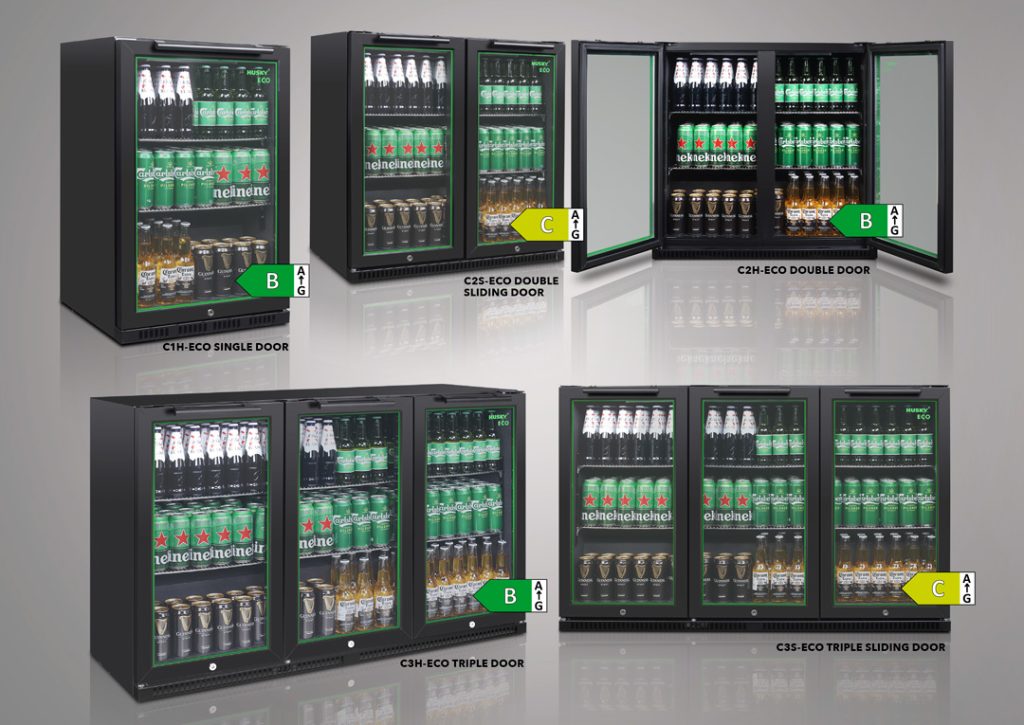
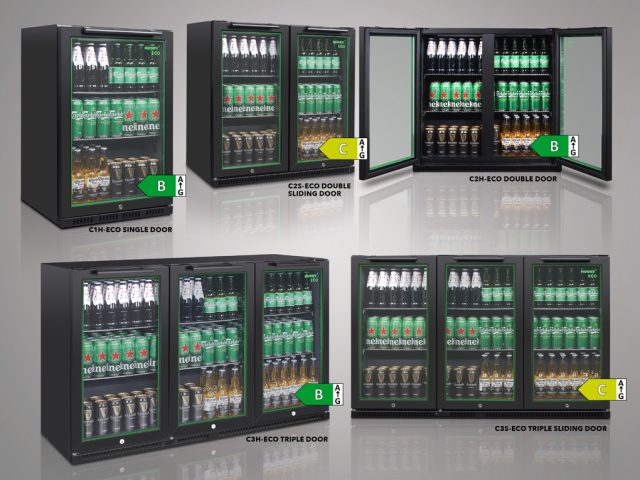
Five glass-door refrigerators display various beverages, including Heineken and Carlsberg bottles, set against a plain background. Labels read: "C1H-ECO SINGLE DOOR," "C25-ECO DOUBLE SLIDING DOOR," "C2H-ECO DOUBLE DOOR," "C3H-ECO TRIPLE DOOR," "C35-ECO TRIPLE SLIDING DOOR." Energy ratings are shown with "B" and "C" symbols.

The challenge

Two pressures met at the same moment, and together they set the brief.


The first was cost. Electricity prices for retail and convenience operators kept climbing, and running costs became an ever-larger share of the total cost of owning a display fridge. A cabinet that runs around the clock, every day of the year, stops being a one-off purchase and starts being a standing monthly bill. Customers were asking for the same performance at a lower cost to run.


The second was environmental. A company-wide commitment to reducing Husky’s CO₂ footprint pushed the project beyond simple compliance. The brief was to design a range that businesses could feel genuinely good about running, every day, for years, not just one that ticked a regulatory box.


The difficulty was that the obvious way to cut energy consumption is to compromise: thinner performance, dimmer lighting, cheaper components, a narrower temperature range. Any of those would have solved the energy problem by breaking the thing that made the PRO range worth buying in the first place.
The Criteria

The project ran against two sets of criteria. The first was a list of things that were not allowed to get worse. The second was the reason for doing the work at all.

Retained from PRO, non-negotiable

  • Wide temperature flexibility. 0°C to 10°C, covering everything from chilled drinks and non-perishables through to full M1 dairy-safe storage.
  • Built to last. Robust cabinet construction that customers already trusted, to the same durability standard as the PRO range.
  • Merchandising impact. Full-height LED lighting and clear merchandising visibility. The cabinet still had to sell stock.

New for ECO

  • Efficiency leadership. One of the most energy-efficient display coolers on the market, not a marginal improvement.
  • Genuinely lower impact. Natural refrigerants with near-zero global warming potential, compliant with current and future environmental standards.
  • Durable by design. Efficient components specified for a long working life, not just a good first year.
  • Easy to service. Features that reduce maintenance call-outs across the product’s working life.

The Solution

We did not just assemble appliances. Every component was questioned, from insulation to airflow, to find the next efficiency gain. No single change delivered the result. The result is what happens when you make every change at once.

Precision engineering

  • Smarter insulation. A re-engineered foaming process and refined internal components lift thermal efficiency, cutting energy consumption while holding temperature steady.
  • Self-closing doors. In a busy shop, doors get left open, and that is wasted energy. ECO doors shut automatically, so preserving cold air never depends on staff remembering.
  • Low-heat fan system. Standard fans generate unwanted heat that the cabinet then has to remove again. The ECO fan is quieter and more efficient, and keeps chilled air circulating without warming the cabinet.
  • Precision cooling. Most thermostats overcorrect, and every overcorrection costs power. The ECO intelligent thermostat holds a steady temperature with far less fluctuation, so less energy is wasted swinging back and forth.

Naturally greener

ECO models run on natural refrigerants, chosen for near-zero global warming potential and lower energy demand. Both are fully compliant with current and future environmental standards, which directly supports Husky’s CO₂ reduction goals.

Model Refrigerant Global warming potential
C5 ECO R600a (isobutane) Near-zero
C10 ECO R290 (propane) Near-zero

Built to last, easy to service

Durability was never up for negotiation. Efficiency had to be added on top of it, not instead of it.

  • Low-maintenance condenser. Engineered to resist dust and debris build-up, so units need less cleaning, generate fewer service call-outs, and keep running efficiently over the long term.
  • Security as standard. Every ECO unit ships with a built-in door lock, giving operators control over stock overnight or during controlled access hours.
  • Designed in Britain. Shaped by a UK-based engineering team working from real retail insight.

Visibility that sells

Efficiency gains would mean nothing if they came at the cost of merchandising impact. Customers shop with their eyes, so the ECO had to sell as hard as the PRO.

  • Full-height halo lighting. Evenly illuminates every shelf from top to bottom, so a bottle on the top shelf and a ready meal down low are both shown in their best light.
  • Crystal-clear doors. Large glass doors give full visibility of stock without opening the fridge, keeping cold air in while driving impulse purchases.
  • Dairy-safe specification. Retained from the PRO range. Units meet the stringent temperature and hygiene requirements of the dairy industry.

The finished range at a glance

SpecificationC5 ECOC10 ECO
Storage capacity364 litres771 litres
Dimensions (H x W x D)1986 x 650 x 729 mm1986 x 1200 x 729 mm
Weight129 kg226 kg
Temperature range0°C to 10°C0°C to 10°C
Energy efficiency classAA
Energy consumption504 kWh/annum869 kWh/annum
Power input644 W1,035 W
Climate class3 (25°C, 60% humidity)3 (25°C, 60% humidity)
RefrigerantR600aR290
Shelves48 (4 rows)
LockYesYes

The Conclusion

The ECO C5 and C10 met the brief without trading one requirement away for another.

Everything the PRO range was bought for survived intact. The 0°C to 10°C range is unchanged, so the cabinet still covers chilled drinks through to full M1 dairy-safe storage. The build standard is unchanged. The lighting still frames the stock, and the doors still sell it. An operator moving from a PRO to an ECO gives up nothing they were relying on.

What changed is the running cost, and it changed by more than an increment. The efficiency work moved the C10 three energy classes, from D to A, which is not the kind of gain that comes from one clever component. It came from questioning all of them at once.

The commercial consequence matters as much as the engineering one. The ECO carries a higher list price than the equivalent PRO, and on a spec sheet that looks like a hurdle. In practice the energy saving clears it inside the first year, and every year after that the operator is simply better off. That reframes the decision: the ECO is not the expensive option, it is the cheaper one on any horizon longer than six months.

The results

The fairest comparison is the Husky C10 PRO against the new C10 ECO. Same 1.2m footprint, same R290 refrigerant, same dairy-safe M1 specification.

C10 PRO C10 ECO Change
Storage capacity 975 litres 771 litres 204 litres less
Energy efficiency class D A Three classes higher
Energy consumption 3,154 kWh/annum 869 kWh/annum 72% less
Energy per litre 3.23 kWh/litre 1.13 kWh/litre 65% less
Refrigerant R290 R290 Unchanged

Being straight about the capacity

The ECO is a smaller box. It holds 771 litres against the PRO’s 975, so part of the saving comes from cooling less space. That is worth saying plainly, because any buyer comparing spec sheets will spot it.

The engineering still stands up on its own. Measured per litre of storage, the C10 ECO uses 1.13 kWh a year against the C10 PRO’s 3.23, which is 65% less energy for every litre cooled. The 72% headline is what an operator actually saves on the bill. The 65% is what the engineering delivered. Both are true, and the second is the one that survives scrutiny.

What it means on the bill

Efficiency classes are abstract. Money is not. Here is the same comparison expressed the way an operator will think about it.

Per C10 unit, per year Figure
Energy saved against the C10 PRO 2,285 kWh
Electricity cost saved (at 25p/kWh) £571
CO₂e avoided 404 kg
Payback on the £300 price premium Around 6 months

Costed at 25p per kWh, a deliberately conservative figure. UK small-business electricity averaged around 27.8p per kWh in early 2026, at which the annual saving is closer to £635 and the premium pays back inside six months. Carbon calculated using the 2025 DESNZ grid electricity factor of 0.177 kgCO₂e per kWh.

Over a ten-year working life

One C10 ECO saves around 22,850 kWh, close to £5,700 in electricity, and roughly four tonnes of CO₂e against the C10 PRO it replaces. Multiply that across an estate and the range stops being a product decision and starts being an energy strategy.

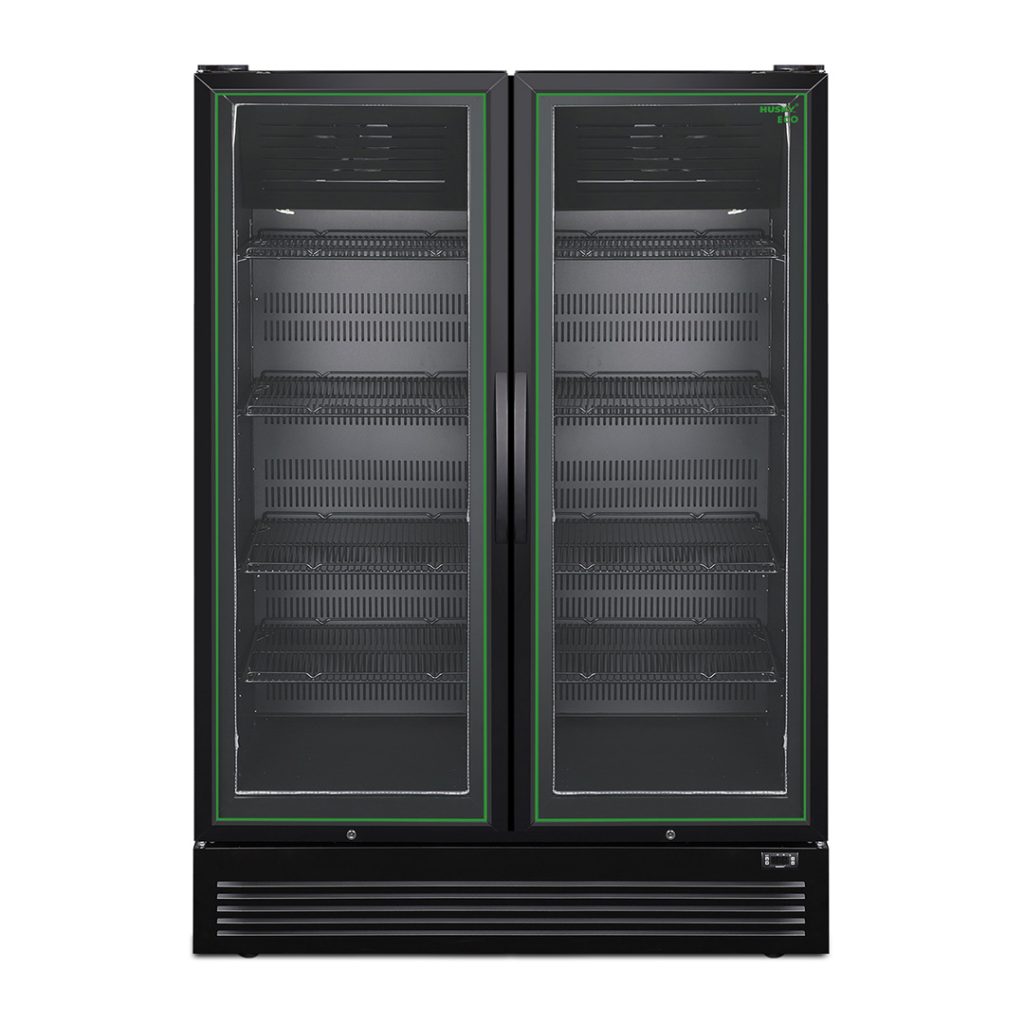
A large, black double-door commercial refrigerator stands idle, with empty glass shelves visible through transparent doors. The setting appears to be industrial or retail-oriented.

PROJECTHusky in-house product development programme. The ECO range as an evolution of the PRO range.

SectorCommercial and Retail (convenience stores, forecourts, off-licences, supermarkets and food-to-go).

LocationDesigned and engineered in Britain by Husky’s UK engineering team. Sold across UK and international markets.

Range ECO upright glass-door display chillers. C5 single door (364 litres) and C10 double door (771 litres), both 0°C to 10°C and dairy-safe to M1. Part of the wider ECO upright range covering chilled and frozen

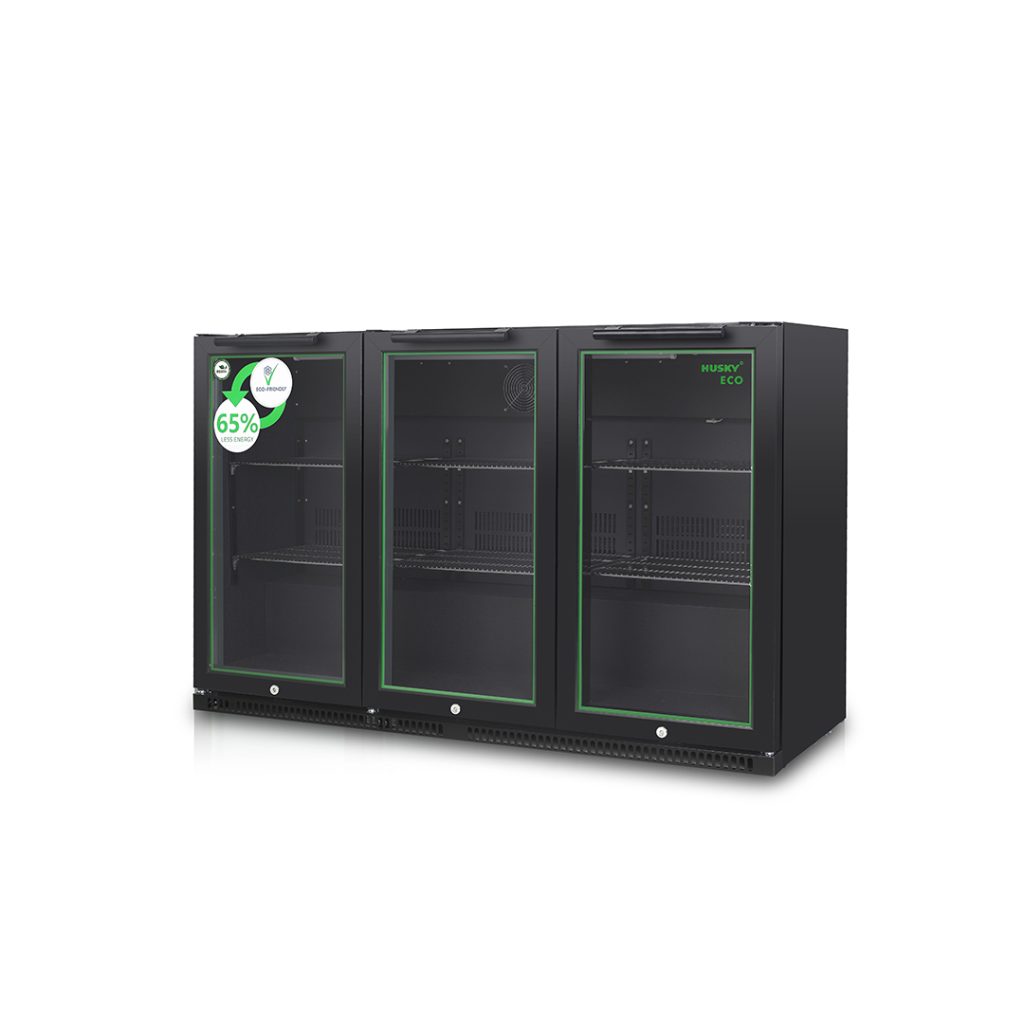
A three-door black commercial refrigerator with sleek, glass-front doors stands in a plain white setting. There's a sticker on the left reading, "65% less energy." The right side is labeled "HUSKY ECO."

KEEP READING

More case studies

Husky ECO C5 & C10

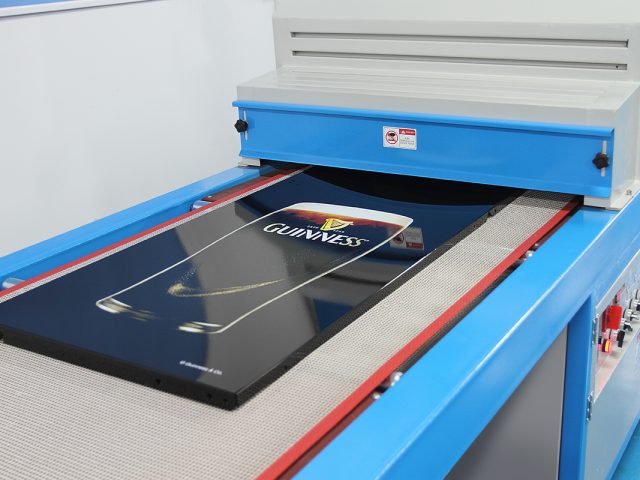
Printed decals and stickers fade, peel and discolour over time — leaving premium brands looking dated and devaluing the product on display. Husky's direct-to-metal silk screen printing solves it, using...
Read More...

WORK WITH HUSKY

Have a tricky refrigeration brief?

Tell us the problem and the conditions. Husky’s British engineering team will design a solution that fits, from one cabinet to a global rollout.