How the ECO Range Was Redesigned from the Ground Up - Why Energy Efficiency Wins Tenders
For most of the last decade, a display fridge was bought on three questions: how much does it hold, how good does the stock look and how long will it last? Those still matter. But anyone who has sat on either side of a refrigeration tender recently knows a fourth question now decides the outcome: what does it cost to run?
That shift is why the Husky ECO Range exists. It was not a refresh or a rebadge. Every component was reconsidered, from the foam in the walls to the logic in the thermostat, with one goal: to become one of the most energy-efficient commercial cooling ranges on the market whilst giving up nothing the previous range was trusted for. This is the story of how it was done, and why that work is now the difference between winning and losing a tender.
The ground shifted under the spec sheet
Three pressures arrived at once, and together they rewrote the buying criteria.
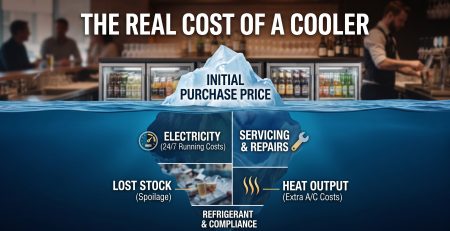
Energy became a standing bill, not a footnote. A glass-door cooler runs 24 hours a day, 365 days a year. When electricity was cheap, that was tolerable. It no longer is. Energy prices for UK hospitality businesses rose by an average of 65% over ten years, with pubs and bars seeing a 57% increase. In wet-led pubs, electricity typically makes up 55 to 65% of total energy spend, and cellar refrigeration is one of the heaviest single loads. Multiply one inefficient cabinet across an estate of hundreds of sites and the running cost dwarfs the purchase price within a couple of years.
Regulation set a public benchmark. Since 1 March 2021, refrigerating appliances with a direct sales function, including beverage coolers, have carried an EU energy label on an A to G scale, and the accompanying ecodesign regulation introduced further requirements from September 2023. Every cabinet now wears its efficiency class where a procurement team can see it. There is nowhere for a poor performer to hide.
Brand owners started counting cooler emissions. For the drinks companies whose logos sit on the front of these units, cooler fleets are a material sustainability line. Coca-Cola HBC reports that packaging, ingredients and coolers account for more than 90% of its Scope 3 emissions, and it has already passed its 2025 target for energy-efficient coolers, reaching 66% of units in outlets against a goal of 50%. When a bottler or brewer issues a tender, cabinet efficiency is no longer a nice-to-have. It is a reporting obligation.
Public sector buyers have moved the same way. Under the Procurement Act 2023, the ‘most advantageous tender’ test replaces the old ‘most economically advantageous tender’, allowing quality, innovation and environmental impact to carry real weight, and in some cases to be the deciding factor.
Put those together and the brief for any new commercial cooler writes itself: match the performance people already rely on, then cut the energy it takes to deliver it. Dramatically.
What 'from the ground up' actually meant
The easy way to cut a fridge’s energy use is to compromise: dimmer lighting, a narrower temperature range, cheaper components. Husky’s engineering team ruled that out from day one. The retained criteria were non-negotiable: the full 0°C to 10°C temperature range covering chilled drinks through to M1 dairy-safe storage, the same cabinet durability and full-height LED lighting that still sells the stock.
With those fixed, the team went through the cabinet component by component. No single change delivered the result; it came from making every change at once.
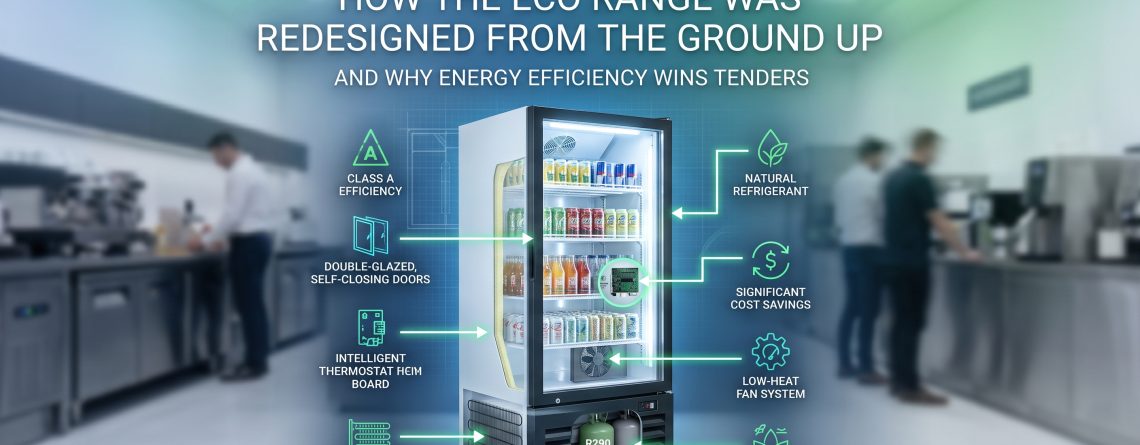
- Insulation. A re-engineered foaming process and refined internal components raised thermal efficiency, so the cabinet holds temperature with less compressor work.
- Doors. Double-glazed glass on the back bar units reduces heat transfer, and on the upright ECO cabinets the doors self-close, so keeping cold air in never depends on a busy member of staff remembering.
- Airflow. Conventional fans add heat that the cabinet then has to remove again; the ECO’s low-heat fan system circulates chilled air quietly without warming the interior.
- Control. Most thermostats overshoot, and every overshoot costs power. The ECO’s intelligent thermostat holds a steady temperature with far less swing.
- Refrigerant. The range runs on natural refrigerants, R600a in the C5 and R290 in the C10, both with near-zero global warming potential.
- Serviceability. A low-maintenance condenser resists dust build-up, so units need less cleaning, generate fewer call-outs and keep running efficiently for longer.
Every one of these was validated rather than assumed. Husky’s high-efficiency systems are tested in DEKRA-accredited laboratories, which matters when a tender asks for evidence rather than a brochure claim.
The numbers a tender evaluator actually reads
The fairest like-for-like comparison is the C10 PRO against the C10 ECO: same 1.2 m footprint, same R290 refrigerant, same M1 dairy-safe specification.
The ECO moved the C10 three energy classes, from D to A, and cut annual consumption from 3,154 kWh to 869 kWh, a 72% reduction. The C5 ECO, the single-door sibling, is also class A at 504 kWh a year.
It is worth being straight about one thing, because a good evaluator will spot it. The ECO C10 is a slightly smaller cabinet, holding 771 litres against the PRO’s 975, so part of the saving comes from cooling less space. Measured per litre, the ECO uses 1.13 kWh a year against 3.23, which is 65% less energy for every litre cooled. The 72% is what shows up on the bill. The 65% is what the engineering delivered. Both stand up to scrutiny, and in a tender, surviving scrutiny is the whole game.
Translated into money: at a conservative 25p per kWh, one C10 ECO saves around 2,285 kWh and £571 a year against the PRO, avoiding roughly 404 kg of CO₂e, and pays back its price premium in around six months. Over a ten-year working life that is close to 22,850 kWh, around £5,700 in electricity and roughly four tonnes of CO₂e per unit. Across a 500-site estate, that is a seven-figure operating saving and a carbon reduction a sustainability team can put in the annual report.
Why this is what wins tenders
Tender scoring has changed in a way that rewards exactly this kind of engineering, for four reasons.
Whole-life cost beats list price. Procurement teams increasingly model total cost of ownership over five to ten years rather than comparing invoices. On that basis a class A cabinet with a modest premium is not the expensive option; it is the cheapest one on any horizon longer than a few months. A bid built on list price alone now looks like it has missed the question.
Compliance is a gate, efficiency is a differentiator. Meeting current ecodesign minimums gets a supplier through the door. Sitting at the top of the A to G scale, on natural refrigerants that are already ahead of future F-gas restrictions, is what separates bids once everyone in the room is compliant.
Brand owners need the data. Bottlers, brewers and retailers reporting on Scope 3 need suppliers who can hand over verified kWh per unit, refrigerant GWP and lab-validated performance. A cabinet that arrives with that paperwork saves the buyer work and de-risks their own reporting
Service life protects the business case. An efficient fridge that degrades after 18 months delivers none of the savings the bid promised. Durable components, a dust-resistant condenser and self-closing doors were specified for a long working life, not just a good first year, so the modelled saving is the real one.
Efficiency that does not cost you the sale
None of this would matter if the ECO merchandised worse than the cabinet it replaced. It does not. Full-height halo lighting illuminates every shelf evenly, large glass doors give full stock visibility without opening the fridge, and every unit ships with a door lock as standard. Custom branding is available across the range, so the cabinet still works as hard for the brand as it does for the energy bill.
Because Husky develops each technology independently, operators can specify the ECO cabinet as their base and add connectivity, remote monitoring or in-fridge inventory tracking as their needs grow. The efficient fridge comes first. Everything else builds on it.
The bottom line
The ECO Range was redesigned from the ground up because the market’s question changed, and a cabinet that answers the old question is no longer competitive. Energy efficiency wins tenders because it is now measurable, reportable and directly convertible into pounds on an operator’s electricity bill and tonnes on a brand owner’s carbon ledger. Husky built the ECO to lead on all three.
If you are preparing a refrigeration specification or responding to a tender, talk to the Husky team. We can supply the lab-validated energy data, refrigerant details and whole-life cost modelling your evaluators will ask for.