What Is the Real Cost of a Cooler?
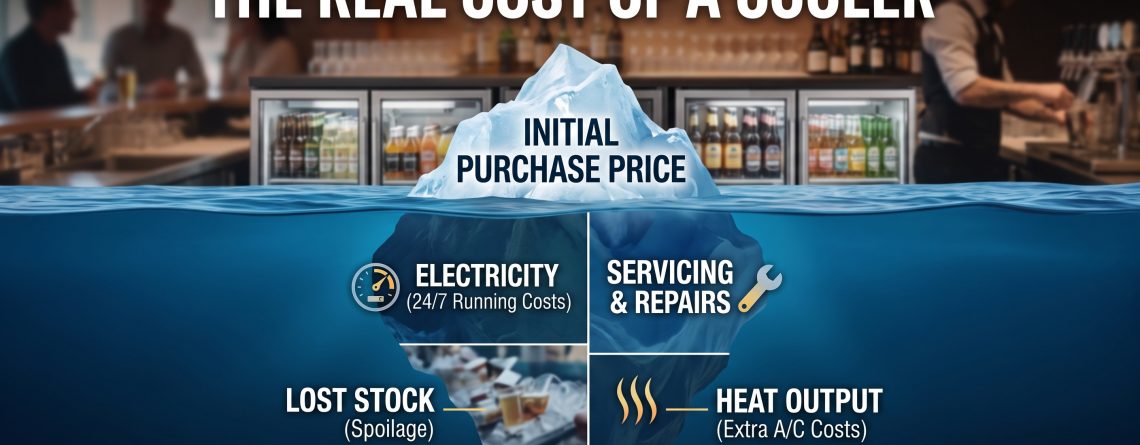
Ask most bar or shop owners what a cooler costs and they’ll quote you the price on the invoice. It’s an honest answer, but it’s the wrong one. The purchase price is the one number you pay once. Everything else – electricity, servicing, lost stock, the heat it pumps into your bar – you pay for every single day the unit is switched on. And a commercial cooler is never switched off.
Over a typical service life, the sticker price can end up being the smallest line on the bill. Here’s how the real cost breaks down.
1. Electricity: the cost that never stops
A back bar cooler runs 24 hours a day, 365 days a year. That makes its energy consumption the single biggest factor in what it actually costs you to own.
The gap between models is far wider than most buyers realise. Husky’s own comparison basis puts an average back bar fridge at around 2.16 kWh per day, against 0.6 kWh per day for a Husky Eco model. That’s not a marginal difference; it’s more than three and a half times the energy for the same job.
Now put a price on it. As of September 2026, UK business electricity unit rates sit at roughly 26.4p to 27.2p per kWh depending on business size. Using 27p as a working figure:
Average back bar cooler: 2.16 kWh × 365 days ≈ 788 kWh a year, or around £213 per unit, per year
Husky Eco cooler: 0.6 kWh × 365 days ≈ 219 kWh a year, or around £59 per unit, per year
That’s a difference of roughly £154 per cooler, every year. Refurbishment in hospitality typically happens every seven to ten years, so over a seven-year life the running cost gap on a single unit is over £1,000. A pub or venue with ten back bar coolers is looking at a five-figure difference in electricity alone – before you’ve factored in a single price rise.
And prices are only heading one way. Electricity is still around 75% higher than pre-2021 levels, and network charges rose by roughly 60% from April 2026. Every increase widens the gap between an efficient cooler and an inefficient one.
2. Refrigeration is a bigger slice of your bill than you think
It’s easy to dismiss a single fridge as a rounding error. Collectively, they aren’t. Refrigeration is the biggest source of electricity used in a restaurant, accounting for around 43% of consumption, because fridges and freezers never switch off. For pubs and clubs, refrigeration has historically been estimated at around 30% of energy costs.
When one category of equipment accounts for a third or more of your electricity, the efficiency of each unit stops being a nice-to-have and becomes a genuine profit lever.
3. The heat you don't see
Every watt a cooler consumes ends up as heat rejected into the room. An inefficient unit is quietly working against your air conditioning all summer long. Bar refrigeration works harder in summer, precisely when air conditioning and cooling loads peak. Cut the cooler’s consumption and you cut that secondary load too – a saving that never appears on a spec sheet but does appear on your bill.
4. Servicing, breakdowns and lost stock
Cheap components fail sooner. A compressor that struggles to hold temperature runs longer, wears faster and is more likely to fail on the busiest weekend of the year. Each call-out has a direct cost, but the indirect cost is often worse: warm stock, wasted product, disappointed customers and staff scrambling for workarounds. A cooler that holds temperature reliably and pulls down quickly after the doors have been opened a hundred times on a Friday night is protecting your margin as much as your drinks.
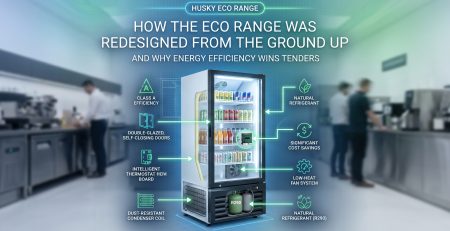
Design choices matter here too. Features that keep condenser coils clear of debris extend the life of the unit and keep it running at its rated efficiency instead of degrading year on year. Low-E double-glazed doors, LED lighting and electronically controlled fans all reduce the strain on the compressor, which is the most expensive part to replace.
5. Refrigerant and compliance
The refrigerant inside the cabinet is part of the real cost too. Older synthetic gases carry high global warming potential, come with tightening regulatory restrictions and can be costly to handle at service and end of life. Husky’s Eco coolers run on R600a, a natural hydrocarbon refrigerant with very low global warming potential, which keeps you ahead of regulation rather than chasing it.
6. The carbon cost
For businesses that report on emissions, or simply want to, energy efficiency has a second payoff. Electricity is typically the largest emission source in absolute terms for hospitality businesses, so every kWh you don’t use is carbon you don’t have to account for or offset.
Putting it all together
Here’s the honest comparison for a single back bar cooler over seven years, using the figures above:
Average back bar cooler | Husky Eco cooler | |
|---|---|---|
Energy per year | ~788 kWh | ~219 kWh |
Electricity per year (at 27p/kWh) | ~£213 | ~£59 |
Electricity over 7 years | ~£1,490 | ~£414 |
Difference | ~£1,076 per unit |
That’s before servicing, stock loss, air-conditioning load or any future price rises – all of which fall more heavily on the less efficient unit. Multiply by every cooler on site, and the cheaper cabinet on the invoice is very often the more expensive one to own.
The question to ask before you buy
Don’t ask ‘how much is it?’. Ask ‘how much does it use?’. Look for the annual energy consumption figure in kWh rather than relying on the rating letter alone, and do the multiplication against your own unit rate. It takes thirty seconds and it will tell you more about the true cost of a cooler than the price tag ever will.
Husky has spent over 30 years engineering refrigeration that costs less to run, backed by our own manufacturing facility and in-house test centre. If you’d like to see what the Eco range would save across your estate, get in touch – we’re happy to run the numbers for your sites.